Sunday, April 3, 2016

Leaf Anole, Anolis planiceps (Family Dactyloidae)

Anolis planiceps Troschel 1848: 649

Anolis chrysolepis planiceps - Vanzolini & Williams 1970: 85

Anolis nitens nitens - Avila-Pires 1995


Type locality: Caracas, Venezuela. Holotype: ZMB 529.

Distribution. E Venezuela, Guyana, Brazil (Roraima, Amazonas), Trinidad.

The leaf anole, Anolis planiceps, occurs in Venezuela, Guyana, and Trinidad . Trinidad localities include Tucker Valley; Port of Spain, Maracas Valley, Nariva Swamp, Chacachacare and Huevos, Aripo savannas, Arena Forest; southwestern peninsula near Bonasse. St. Augustine; Mt. St. Benedict; La Seita; Toco; Morgua; Guayaguayare; Mayaro; Chacachacare Island; and Huevos Island. This lizard is found on tree trunks, on the ground, and sleeping on leaves at night. It is a forest and forest edge species and
until now the only species of Anolis on Trinidad that is native to the island. All other species have been introduced. However we have recently found Anolis tigrinus on Tobago and seen photographic evidence that it is also present on Trinidad.


Based on specimens labeled Anolis planiceps in Vertnet

Zandolie, Jungle Runner, Giant Ameiva, Ameiva atrigularis (Family Teiidae)


Ameiva surinamensis var. atrigularis Garman 1887.
Ameiva ameiva ameiva — Marcuzzi 1950: 101 (part.)
Ameiva ameiva tobagana — Peters & Donoso-Barros 1970: 20.
Ameiva ameiva atrigularis — Tuck & Hardy 1973: 241
Ameiva ameiva — Murphy 1997: 152
Ameiva atrigularis — Ugueto & Harvey 2011

Taxonomy & Systematics. This account follows
 Ugueto and Harvey (2011).

Distribution. Northern Venezuela including the Distrito Capital, Vargas, Miranda, Sucre, Peninsula de Paria, Isla de Margarita), Trinidad, Tobago, Little Tobago and satellites.

Natural History. This is a giant species of Ameiva, with adults reaching a body size that may exceed 0.5 m. The Zandolie is omnivorous, feeding on insects, small vertebrates, and fruits. It is visible on bright sunny days when it is
searching for food and mates, at other times they
are
concealed in burrows. Females are oviparous and probably lay several clutches of eggs annually. Habitats used are deciduous tropical and premontane humid forest, forest-edge, as well as areas of forest with open undergrowth where patches of light reach the forest floor, scrub lands, secondary growth, suburban yards and gardens, roadsides, and beaches.


Barbour, T. and Noble G.K.. 1915. A revision of the lizards of the genus Ameiva. Bull. Mus. Comp. Zool. Harvard 59: 417-479. - get paper here

Burt, C.E. & Burt, M.D. 1931. South American lizards in the collection of the American Museum of Natural History. Bull. Amer. Mus. nat. Hist. 61 (7): 227-395

Garman, S. 1887. On the West Indian Teiids in the Museum of Comparative Zoology. Bull. Essex Inst. 19: 1-12.

Gorzula, Stefan & Senaris, J. C. 1999. In: Contribution to the herpetofauna of the Venezuelan Guayana. I: a data base. Scientia Guaianae, Caracas, No. 8 [1998], 269+ pp.

Murphy, J.C. 1997. Amphibians & Reptiles of Trinidad & Tobago. Krieger Publishing Company, Malabar, Florida, 304 pp.

Peters, James A. & Donoso-Barros, R. 1970. Catalogue of the Neotropical Squamata: Part II. Lizards and Amphisbaenians. Bull. US Natl. Mus. 297: 293 pp.

Rivas Fuenmayor, G. and Barrio AmorĂ³s C.L. 2005. New Amphibian and Reptile records from Cojedes State, Venezuela. Herpetological Review 36 (2):205-209.

Roze, J.A. 1964. La herpetologia de la Isla de Margarita, Venezuela. Soc. de Cienc. Natur. 'La Salle', Caracas, Mem. 24(69): 209-241.

Tuck, R. G., Hardy, J.D. 1973. Status of the Ober Tabago collection, Smithsonian Institution, and the proper allocation of Ameiva surinamensis tobaganus Cope (Sauria: Teiidae). Proc. Biol. Soc. Washington 86 (19): 231-242

Ugueto, G. N. and Harvey M.B. 2011. Revision of Ameiva ameiva Linnaeus (Squamata: Teiidae) in Venezuela: Recognition of Four Species and Status of Introduced Populations in Southern Florida, USA. Herpetological Monographs 25 (1): 112-170.

Friday, April 1, 2016

Paradox Frog, Pseudis paradoxus caribensis Galllardo

Rana paradoxa Linnaeus, 1758: 212. Type locality: Suriname.

Pseudes paradoxa — Wiegmann, 1832: 148.

Pseudis paradoxus caribensis Gallardo, 1961. Holotype: MCZ 19890, by original designation. Type locality: Mayaro Bay, Trinidad.


Adults are 45-75 mm in total length. Body is short and stout; eyes dorsolateral; dorsal and ventral skin; fingers free of webbing, toes heavily webbed. Dorsum green anteriorly, brown to green posteriorly; flash marks on posterior surface of femur. Ventral immaculate white. has the largest, or near largest tadpoles known when compared to adult size. Tadpoles are 220 mm (3 to 4 times longer than adult frogs). As currently defined it is known from the following countries: Argentina, Bolivia, Brazil, Colombia, French Guiana, Guyana, Paraguay, Peru, Suriname, Trinidad (unknown from Tobago), and Venezuela. Usually found in open marshy areas with floating vegetation, in permanent and temporary ponds. Calls can be heard day and night and consists of a sequence of 8-11 pulses, but frogs are very wary during the day. At night they can be seen floating on the surface and grasping vegetation with their hands. Mating may be stimulated by rainfall. Eggs are green and laid along the shore among aquatic plants.

 Abstract from Aguiar et al. (2007)
The previous uncertain placement of Lysapsus and Pseudis within the neobatrachians was recently resolved by molecular and morphological studies, which supported them as members of the Hylinae subfamily. Their inter- and intrageneric relationships, however, have long been under debate and no studies shed light on these questions. Aiming to elucidate such questions, this paper used 3.2 kb comprising the mitochondrial genes 12S, tRNA valine, 16S and cytochrome b, and the nuclear exon 1 coding for rhodopsin, to all representatives of both genera (except to two subspecies of Pseudis paradoxa). The results identified three major clades: the clade 1 was composed by Lysapsus species and subspecies; clade 2 included the subspecies of the Pseudis paradoxa (Pseudis paradoxa paradoxa, P. paradoxa platensis and P. paradoxa occidentalis), P. fusca, P. bolbodactyla and P. tocantins, and clade 3 was composed by Pseudis southern Brazil species (Pseudis cardosoi and P. minuta). As closely related taxa we found Pseudis minuta + P. cardosoi; P. tocantins + P. fusca, and the subspecies within each genus. Evidence that Pseudis is not monophyletic with respect to Lysapsus was found and we suggest Lysapsus to be a junior synonym of Pseudis. Based on pair-wise comparison among gene sequences, we also suggest that the subspecies of Pseudis paradoxa and Lysapsus limellum must be considered as full species.

Aguiar O, Bacci M, Lima AP, Rossa‐Feres D, Haddad CF, Recco‐Pimentel SM. Phylogenetic relationships of Pseudis and Lysapsus (Anura, Hylidae, Hylinae) inferred from mitochondrial and nuclear gene sequences. Cladistics. 2007 Oct 1;23(5):455-63.

Pseudis paradoxa habitat on Trinidad
Range of Pseudis paradoxa from AmphibiaWeb

Range of Pseudis paradoxa on Trinidad

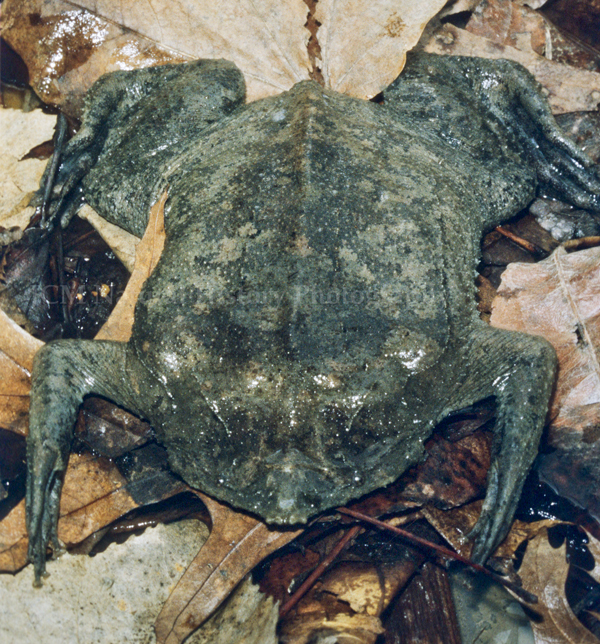
Suriname Toad, Pipa pipa (Family Pipidae)

Rana Pipa Linnaeus, 1758: 210.
Pipa americana Laurenti, 1768: 25.

Ranges throughout South America from Ecuador to Guianas and southward to Peru, Bolivia, and Brazil. It is also present on Trinidad (absent from Tobago). Pipa pipa is aquatic inhabiting the muddy bottoms of tropical rivers. The fingers end in star-shaped, filamentous tactile organs to detect food. Pipa pipa uses vacuum feeding similar to that of the mata mata turtle. It feeds on aquatic invertebrates and fish. During courtship the male fertilizes the eggs and then positions them so they attach to the female's back. The skin of the female grows around the fertilized eggs and the embryos develop with the females skin. They hatch after 90-120 days of incubation as miniature adults, about 20 mm in length. On Trinidad all of the records are from the southern portion of the island.

Bromeliad-dwelling Treefrog, Phytotriades auratus (Family Hylidae)

Amphodus auratus Boulenger, 1917:185. Syntypes: BMNH 1917.9.27.39-41. Type locality: Mount Tucuche, a little above 3000 feet altitude, Trinidad.

Phyllodytes auratus — Bokermann, 1968, Rev. Brasil. Biol., 28: 157-160.

Phytotriades auratus — Jowers, Downie, and Cohen, 2009, Stud. Neotrop. Fauna Environ., 43: 186.

Previously known from the type locality at the summit of Mt. Tucuche and Mt Aripo. it has been recently discovered on Cerro de Humo, PenĂ­nsula de Paria, Sucre, Venezuela , in Venezuela. It does not occur on Tobago. The total range of the species is estimated to be 10km² or less on Trinidad, and about 2 hectares in Venezuela. It is known from 940-1250 m asl. It is found in montane rainforest and elfin woodland. It has a very specific microhabitat and is associated with the giant epiphytic bromeliad, Glomeropitcairnia erectiflora. It breeds by larval development in bromeliads. Probably the greatest threat to this species is climate change. As the climate becomes warmer and drier, it could be threatened by fires. Rivas and Freitas. 2015. Herp Review 46(2):153-156. 

Flashy Narrow-mouth Frog, Elachistocleis surinamensis (Family Microhylidae)


See comment under E. ovalis. This species ranges widely in northern Venezuela, east to northern Suriname, and it is also present on Trinidad (unknown from Tobago). It occurring up to at least 500 m asl, and all records are from close to sea level. It is terrestrial in tropical forest, including closed-canopy secondary forest, and possibly also coastal savannahs. In Trinidad 
animals occur in the forest leaf-litter; males may be found calling from small water-filled stump holes. It is not found in open country on Trinidad. but is associated with wooded areas at Aripo Savanna. Spawning takes place in temporary pools, the eggs float and are non-adhesive, and the larvae develop in the same water bodies. It has been suggested this species is possibly the same species as E. ovalis. It is possible that Relictivomer pearsei is a synonym of this species (and it was treated as such by Kenny (1969).  Like other members of the genus it is a leaf litter inhabitant that feeds on ants.

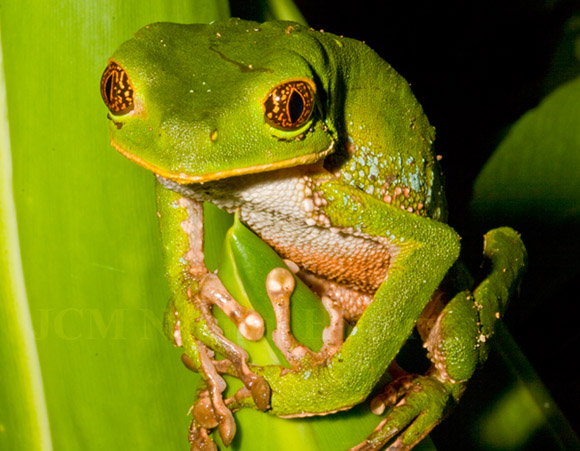
Leaf-nesting Frog, Phyllomedusa trinitatis (Family Hylidae)

Phyllomedusa trinitatis Mertens, 1926: 145. Holotype: SMF 2633. Type locality: Port of Spain, Trinidad.

Phyllomedusa burmeisteri trinitatis — Rivero, 1961, Bull. Mus. Comp. Zool., 126: 148.

Phyllomedusa trinitatis — Rivero, 1961, Bull. Mus. Comp. Zool., 126: 148.


Pithecopus trinitatis — Lutz, 1966, Copeia, 1966: 236.

This species is widespread on Trinidad, it is unknown from Tobago. It has also been reported from the Paria Peninsula, but the exact identity of the Venezuelan populations remains to be determined. In elevation it ranges from about sea level to more than 950 m. It is a forest and savanna species that uses the understory trees and bushes often near ponds. It is also found by ditches in secondary forests and urbanized habitats with standing water and adjacent vegetation. The female folds a leaf or leaves into a nest which are held together by the adhesive properties of the gelatinous covering of the eggs. When the eggs hatch the tadpoles drop into the water below. We have found the cat-eyed snake (Leptodeira annulata ashmeadi) very close to the nests of this frog.

Trinidad Stream Frog, Mannophryne trinitatis (Family Aromobatidae)

A male transporting tadpoles.
Phyllobates trinitatis Garman, 1888 (1887), Bull. Essex Inst., 19: 13. Type locality: "Trinidad".

Prostherapis trinitatis — Mole and Urich, 1894, J. Trinidad Field Nat. Club, 2: 87.

Prostherapis trinitatis trinitatis — Rivero, 1961, Bull. Mus. Comp. Zool., 126: 155.

Colostethus trinitatus — Edwards, 1971, Proc. Biol. Soc. Washington, 84: 148.

Mannophryne trinitatus — La Marca, 1992, Cuad. Geograf., MĂ©rida, 9: 32.

Mannophryne trinitatis — La Marca, 1994, Publ. Asoc. Amigos Doñana, 4: 52.

Barrio-AmorĂ³s et al., (2006) provided morphological and chromosomal evidence that Mannophryne trinitatis is restricted to the island of Trinidad. The Peninsula de Paria, Venezuelan population was found to be a different species, Mannophryne venezuelensis (Manzanilla et al., 2007).

Distribution. Forested areas of the Northern and Central Ranges of the island of Trinidad, occurring from the upper elevations of the mountainous areas to sea level.

Natural History. Associated with gravel, and sandy substrate streams with shaded. Females deposit eggs at terrestrial locations guarded by the male. Males transport tadpoles to predator free pools that may be some distance from the stream.


Barrio AmorĂ³s, C.L. 2004. Amphibians of Venezuela Systematic List, Distribution and References, An Update. Review of Ecology in Latin America 9(3): 1-48.

Barrio-AmorĂ³s, C.L. Rivas, G., Molina, C., and Kaiser, H. 2006. Mannophryne trinitatis (Anura: Dendrobatidae) a Trinidadian single-island endemic. Herpetological Review 37: 298-299.

Edwards, S.R. 1974. Taxonomic notes on South American Dendrobatid frogs of the genus Colostethus. Occasional Papers of the Museum of Natural History of the University of Kansas: 1-14.

IUCN. 2010. IUCN Red List of Threatened Species (ver. 2010.2). Available at:http://www.iucnredlist.org.

Jowers, M.J. and Downie, J.R. 2004. Distribution of the frog Mannophryne trinitatis (Anura: Dendrobatidae) in Trinidad, West Indies. Living World. Journal of the Trinidad and Tobago Field Naturalists´ Club: 17-19.

Kenny, J.S. 1969. The Amphibia of Trinidad. Studies on the Fauna of Curacao and Other Caribbean Islands.

La Marca, E. 1992. CatĂ¡logo taxonĂ³mico, biogeogrĂ¡fico y bibliogrĂ¡fico de las ranas de Venezuela. Cuadernos GeogrĂ¡ficos, Universidad de Los Andes 1: 1-197.

La Marca, E. 1994. Taxonomy of the frogs of the genus Mannophryne (Amphibia: Anura: Dendrobatidae). Publicaciones de la Asociacion Amigos de Doñana: 1-75.

La Marca, E. 1995. Biological and systematic synopsis of a genus of frogs from Northern mountains of South America (Anura: Dendrobatidae: Mannophryne). Bulletin of the Maryland Herpetological Society: 40-77.

La Marca, E. 1997. Lista actualizada de los anfibios de Venezuela. In: La Marca, E. (ed.), Vertebrados Actuales y Fosiles de Venezuela, pp. 103-120. Museo de Ciencias y Tecnología de Mérida, Mérida.

Manzanilla, J., García-París, M. and La Marca, E. 2002. Filogenia molecular del Género Mannophryne. VII Congreso Luso-Español de Herpetología, Evora, pp. 61. Portugal.

Manzanilla, J., Jowers, M.J., La Marca, E., and GarcĂ­a-ParĂ­s, M. 2007. Taxonomic reassessment of Mannophryne trinitatis (Anura: Dendrobatidae) with a description of a new species from Venezuela. The Herpetological Journal 17: 31-42.

Manzanilla, J., La Marca, E. and GarcĂ­a-ParĂ­s, M. 2003. Evidencias moleculares de la monofilia del gĂ©nero Mannophryne (Anura: Dendrobatidae). VI Congreso Latinoamericano de HerpetologĂ­a, Enero 2003, Lima, PerĂº.

Mole, R.R. and Urich, F.W. 1894. A preliminary list of the reptiles and batrachians of the island of Tobago. Journal of the Trinidad Field Naturalists’ Club: 77-90.

Murphy, J.C. 1997. Amphibians and Reptiles of Trinidad and Tobago. Krieger Publishing Company, Malabar, Florida.

Parker, H.W. 1933. A list of the frogs and toads of Trinidad. Tropical Agriculture 10(1): 8-12.

Narrow mouth frog, Elachistocleis ovalis (Microhylidae)

Frost (2015) suggests the taxonomy and systematics of this species and E. surinamensis are unclear.The name Elachistocleis ovalis is in need of investigation, and is not applied to a biological population. Currently the name is applied to populations from Panama, Trinidad, and Colombia southward, east of the Andes, to Bolivia. However, in Brazil all populations previously thought to be this species are assigned other names. Kenny regarded E. surinamensis as a senior synonym of Relictivomer pearsei. Elachistocleis appears to be the sister taxon of Hypopachus + Gastrophryne. Caramaschi, 2010, Bol. Mus. Nac., Rio de Janeiro, N.S., Zool., 527: 1-30, discussed the difficult nomenclatural and taxonomic history of this taxon and considered the type species, Rana ovalis Schneider, to be a nomen dubium. This has the effect of leaving populations from Panama, Colombia, Venezuela, Peru, Ecuador, Trinidad and Tobago, Guyana, French Guiana, and Surinam without a name.This species inhabits leaf-litter and in tree holes in tropical rainforests and on the forest edge, as well as grasslands and shrublands. Breeding takes place in ponds, and eggs and tadpoles in water. Male specimens have been found calling from water up to 30cm deep, in flooded forest. It is tolerant of some habitat modification and can survive in rural gardens and pastureland. This species is a complex of several species. Specimens from Paraguay, Argentina and Uruguay have been separated from Elachistocleis ovalis as E. bicolor. It feeds primarily on ants.

Tobago Stream Frog, Mannophryne olmonae (Aromobatidae)

Colostethus olmonae Hardy, 1983, Bulletin of the Maryland Herpetological Society, 19: 47. Holotype: USNM 198505, by original designation. Type locality: Bloody Bay, St. John Parish, Tobago, West Indies.

Mannophryne olmonae — La Marca, 1992, Cuadernos GeogrĂ¡ficos. Facultad de Ciencias Forestales, Universidad de Los Andes, MĂ©rida, Venezuela, 9: 32.

Taxonomy & Systematics. Mannophryne olmonae is not closely related to Mannophryne trinitatis (Lehtinen et al.2011, Jowers et al. 2011), as was suggested by Murphy (1997). Kaiser et al. showed the chromosome banding pattern distinguished the two species. The sister taxon of M. olmonae is M. riveroi from the Peninsula de Paria, Venezuela (Lehtinen et al.2011, Jowers et al. 2011).

Distribution. Forested areas of central and eastern Tobago, between 30–490 m asl. The report of this species from Little Tobago Island was an error (Murphy, 1997).

Natural History. The Tobago Stream Frog is associated with rocky or gravel bottom streams and may move away from streams into the leaf litter during heavy rains. Females deposit eggs in terrestrial locations, guarded by the male. Upon hatching the male carries the tadpoles to pools for continued development. The pools may be roadside ditches or flooded areas on the forest floor.


Literature

Hardy, J.D. 1983. A new frog of the genus Colostethus from the island of Tobago, West Indies (Anura: Dendrobatidae). Bulletin Maryland Herpetological Society, 19(2), 47-57.

IUCN SSC Amphibian Specialist Group 2013. Mannophryne olmonae. The IUCN Red List of Threatened Species. Version 2015.1. <www.iucnredlist.org>. Downloaded on 09 June 2015.

Jowers, M.J., MartĂ­nez-Solano, I., Cohen, B.L., Manzanilla, J. and Downie, R.J. 2011. Genetic differentiation in the Trinidad endemic Mannophryne trinitatis (Anura: Aromobatidae): Miocene vicariance, in situ diversification and lack of geographical structuring across the island. Journal of Zoological Systematics and Evolutionary Research 49(2): 133-140.

La Marca, E. 1992. Catalogo taxonomico, biogeografico y bibliografico de las ranas de Venezuela. Cuadernos GeogrĂ¡ficos. Facultad de Ciencias Forestales, Universidad de Los Andes, MĂ©rida, Venezuela 9: 1–197.

Lehtinen, R.M., Wojtowicz, E.A. and Hailey, A. 2011. Male vocalizations, female discrimination and molecular phylogeny: Multiple perspectives on the taxonomic status of a critically endangered Caribbean frog. Journal of Zoology 283: 117-125.

Beebe's Toad, Rhinella beebei (Family Bufonidae)

A low elevation, open habitat species that can be found in agricultural, urbanized, and savanna habitats. It will follow roads into forested areas, but stay in the open habitat at the edge of the road. Like many toads they feed heavily on ants, other insects, and snails. It can be separated from other toads on Trinidad and Tobago by the forward pointing nostrils and the presence of crests on the top of the head. Also, calling males are much smaller than calling male Marine Toads. Males 51 mm, females 61 mm. A toad with cranial crests and ridges, nostrils located on a shelf and directed upward; elongated head with snout extending over jaw; skin covered with small warts. Distribution and Habitats. Trinidad’s lower elevations in open habitats in the Northern and Southern basins; abundant at Aripo Savanna; follow roads into forested areas, but stay in the open habitat at the edge of the road. Life History. Males call from shallow water or land near the water, often ephemeral pools; feeds heavily on ants, other insects, and snails.

Note that this toad has been previously called Rhinella humboldti, a species found west of the Andes.

Dwarf Marsupial Frog, Flectonotus fitzgeraldi (Family Hemiphractidae)


Gastrotheca fitzgeraldi
Parker, 1934, Tropical Agriculture, Trinidad, 11:123. Holotype: BMNH 1947.2.22.41 Type locality: "about 3,000 ft. on Mt. Tucutche", Trinidad.

Nototheca fitzgeraldi: Bokermann, 1950, Pap. Avulsos Zool., SĂ£o Paulo, 9: 218.

Flectonotus fitzgeraldi: Duellman, 1977, Das Tierreich, 95: 11.

A small frog, males reach 19.0 mm; females reach 24.0 mm SVL. (New metamorph below). They have a yellow-brown dorsum. The posterior surfaces of the thighs are brown, and the venter is unpigmented except for specks of white pigment and is otherwise translucent. The dorsal skin is smooth and the scapular region usually lacks diagonal markings. The head is as long as it is wide. The snout is rounded and the small nasals are widely separated. Upper lips have no spots and no suborbital bar is present. The eyes, separated by an interorbital bar, have diameters of 1.9 to 3.0 mm. The tympanum is smaller than the eye. A brood pouch along the dorsum has a middorsal opening, with lateral folds of skin making up the sides. These folds stick together to enclose the pouch during egg brooding. More often than not, the dorsal thighs are barred, while bars are never present on the anterior and posterior thighs. The tarsus is smooth as opposed to tuberculate, and tibia length in males ranges from 8.8-12.2 mm. Fourth toe webbing is predominately penultimate, although it is sometimes half penultimate and antepenultimate. Fifth toe webbing is mainly distal but can be half distal and penultimate (Duellman and Gray 1983).

Distribution: Trinidad and Tobago, Venezuela

Flectonotus fitzgeraldi occurs in humid forests of Trinidad, Tobago and the Peninsula de Paria, Venezuela. It has been found sitting on leaves of bushes and plants at night and on leaf litter during the day. On Trinidad, this tree frog is widespread  from sea level to 950 m in elevation. It is widely distributed on Tobago and is also found in the mountains of the Peninsula de Paria, Venezuela.

Flectonotus fitzgeraldi is crepuscular and nocturnal. Males start calling in the late afternoon and stop an hour or so after sunset. The Female carry the eggs in a dorsal pouch until the eggs hatch at which time they are deposited in a leaf axial pond.

Mating behavior is unknown, but members of Flectonotus are known to have long reproductive seasons and if females were to mate within a week or two after egg deposit, they could theoretically have five broods per season. A female will produce 3-4 embryos, 3.3 on average, with a mean diameter of 3.6 mm. Eggs will brood in her dorsal pouch until developmental stages 39-41. They are then released into bromeliads and aroid leaf bases, where they continue to develop without feeding. Larval development takes place in only 5 days and during this time, the only yolk is consumed (Duellman and Gray 1983).

 On Tobago, it is widespread and associated with forests. It also occurs in the mountains on the Peninsula de Paria, Venezuela. Habitat is humid forests and forest edges. They have been reported in the leaf litter during the day and on bushes at night. However, we have found them in rolled up Heliconia leaves during the day. Males call at sunset and for a short time afterward. Females carry the large fertilized eggs in a pouch on their back, upon hatching the tadpoles are deposited in a leaf axial pond where they undergo development. New metamorph below.


Adult below.