

Monday, October 3, 2022
Cloacal prolapse in a Trinidad frog


Monday, June 13, 2022
Herping in Trinidad and Tobago (Part 1): Environmentally Sensitive Areas


Friday, May 27, 2022
One of Trinidad's elusive frogs: is it restricted to the southwest of the island?

Sunday, January 2, 2022
Conservation of three endemic Pristimantis frogs in Trinidad and Tobago
Pristimantis is one of the most species rich genus of animals on Earth. Trinidad and Tobago has three species of frogs in that genus. One is found in Trinidad and Tobago (Urich's litter frog Pristimantis urichi), the other two are found on Tobago only (Charlotteville litter frog P. charlottevillensis, and Turpin's litter frog P. turpinorum).
A recent published study (link here) provided updated and novel information on the ecology, conservation status, and genetics of these frogs. Based on the conservation status, the frogs were previously listed as Vulnerable, Least Concern, and Vulnerable, respectively (for P. urichi, P. charlottevillensis, P. turpinorum). However, based on the ecological information such as distribution and relative abundance, these were amended to be Least Concern, Vulnerable, and Data Deficient, respectively. More genetic data are needed for populations in South America, but data in this study found that P. turpinorum is closely related to Venezuelan species, more so than P. urichi and P. charlottevillensis.
Further biological information is needed, especially for P. turpinorum which was classified as Data Deficient. How threats such as climate change and land use change will affect these frogs remain larely unknown. Hopefully these gaps will be filled in the near future so as to protect these unique and endemic frogs which play an integral role in biodiversity.
To learn more about one of these three frogs, see this local newspaper story feature (link here).
 Pristimantis turpinorum pair observed in the Main Ridge Forest Reserve. Photo by Renoir Auguste.
Thursday, November 4, 2021
Rediscovery of an elusive snake in Tobago
Snakes are often elusive animals. One can be walking along a forest trail and there could be one hiding in plain sight. The elusiveness of snakes, though, has resulted in some species not being observed for many years, sometimes even for decades. Observing elusive snakes in nature, can thus be rewarding and beneficial, not only for snake enthusiasts, but for the conservation of the species and biodiversity.
An example of a snake that was recently rediscovered on the island of Tobago after going many years without being observed is the Hallowell's ground snake (Atractus fuliginosus). This small harmless snake (up to 30cm long) is a forest dwelling snake that lives in leaf litter. They feed on small soil invertebrates, making them important components of ecological food webs. A recent publication (reference below) documents updated records of this elusive snake on the island of Tobago (West Indies) over the past 7 years where records prior were scarce for more than a decade. Natural history notes on the species were documented based on these rare observations, and bioloigsts now know more about the snake. Perhaps this elusive snake is more common than we realise. Or worse, perhaps it is in danger of becoming extinct.
 Hallowell's ground snake, Atractus fuliginosus. Photo by Renoir Auguste. ||
Reference: Murphy, J.C., Braswell, A.L., Weems, J., Auguste, R.J., Rivas, G.A., Rutherford, M.G., Schargel, W.E., and Jowers, M.J. 2021. The Rediscovery of Hallowell’s Ground Snake, Atractus fuliginosus, on Tobago with Notes on its Natural History. Herpetological Review 52(3): 488-492.

Wednesday, September 22, 2021
The importance of surveying Herpetofauna in EIAs

Tuesday, July 20, 2021

Tuesday, July 13, 2021
Conservation status of the Dwarf Marsupial Frog in Trinidad, Tobago, & Venezuela
 |
| Drawf marsupial frog (Flectonotus fitzgeraldi) female with eggs on back. Photo by Renoir Auguste |
The dwarf marsupial frog is a small frog found in Trinidad, Tobago and Venezuela. It is a forest specialist species usually found in vegetation with closed canopy and near streams. They are called Marsupial frogs because the females carry their eggs in a pouch on their back, like the marsupials from Australia (that have the pouch by their belly).
The International Union for the Conservation of Nature (IUCN) in 2004 regarded the dwarf marsupial frog as endangered. That status remained unchanged for 16 years. However, a team of researchers from Trinidad, Venezuela, UK, EU, & US compiled biological data done on the species in its respective range which provided important information for its conservation. Based on the surveys, the frog was found to be widely distributed across Trinidad, northeast Tobago and northeastern Venezuela. As such, the group, lead by professor Roger Downie from Glasgow University suggested that the conservation status be downgraded from Endangered to Least Concern.
This is an important milestone for this species based on the updated information provided by this study. However, further studies on number of individuals in its range are needed to continuously monitor the species, as it can potentially revert to its more threatened status because of climate change, habitat alteration and diseases because of its very specific habitat requirements.
Reference:
Smith, J., Jowers, M.J., Auguste, R.J., Hoskisson, P., Beyts, C., Muir, G., Greener, M.S., Thornham, D., Byrne, I., Lehtinen, R., Eyre, M., Rutherford, M.G., Murphy, J.C., De Freitas, M., Rivas G.A., and Downie, J.R. 2021. The distribution and conservation status of the dwarf marsupial frog (Flectonotus fitzgeraldi) in Trinidad, Tobago and Venezuela. Amphibian and Reptile Conservation 15(1): 36-56.
Link to paper here: http://amphibian-reptile-conservation.org/pdfs/Volume/Vol_15_no_1/ARC_15_1_[General_Section]_36-56_e273.pdf
Wednesday, June 23, 2021
Rutherford's Vine Snake From Trinidad Specializes In Eating Lizards

Saturday, May 8, 2021
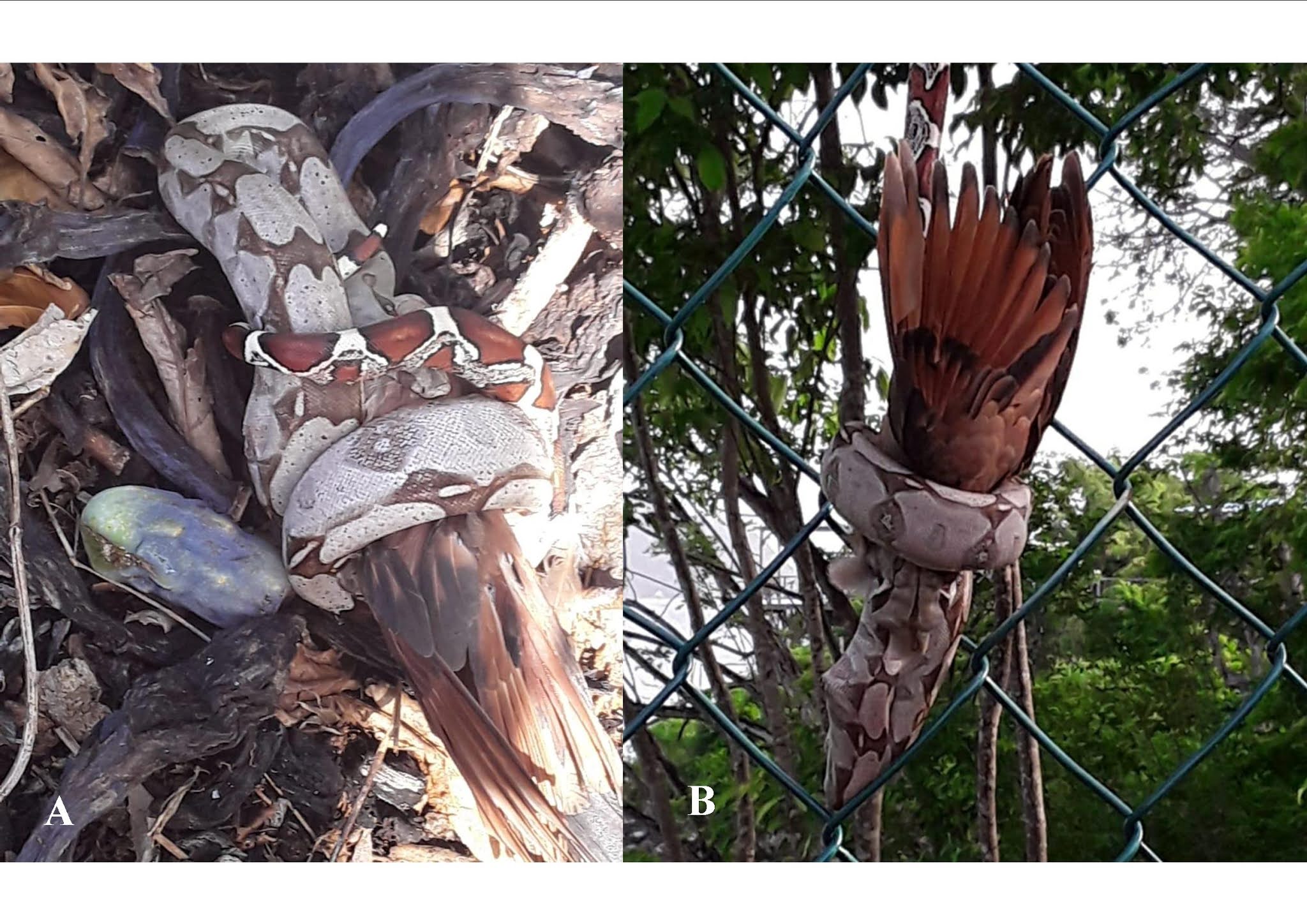
Boa constrictor feeds on a variety of prey, including doves
Sunday, February 28, 2021
A new species of frog re-described from Trinidad

Tuesday, December 29, 2020
A new lizard recorded for Trinidad & the importance of Citizen Science
 |
| Mourning gecko (Lepidodactylus lugubris). Photo by Adam Fifi |
Among exotic reptiles, lizards are the most abundant group introduced to new regions, and even to different countries. One particular group of lizards seem to drift far away from their native countries - Geckoes! No doubt, human facilitation through movement of goods and people have aided in the distribution of animals, including lizards.
Trinidad and Tobago has had at least a half a dozen lizards introduced to the country. Most of these have been Anolis lizards (at least 6 species). However geckoes are about halfway behind with at least 3 new species to the country. One of these is the mourning gecko (Lepidodactylus lugubris). The gecko was first reported on the citizen science application iNaturalist, and have subsequently been found by others across the country. This short natural history note documents their distribution in the scientific literature for the first time, and commends the efforts of persons that took photos and uploaded to iNaturalist.
If you don't use or are familiar with iNaturalist, it is highly recommended. Who knows, maybe you may photograph an animal in the country and it turns out to be a new record for the country!
Reference:
Auguste, R.J., Fifi, A. 2020. Additional record of the invasive mourning gecko Lepidodactylus lugubris (Duméril and Bibron, 1836) from Trinidad and Tobago, with comments on citizen science observations. Herpetology Notes 13: 1111-1112 (link to pdf of paper here)
Subscribe to:
Posts (Atom)